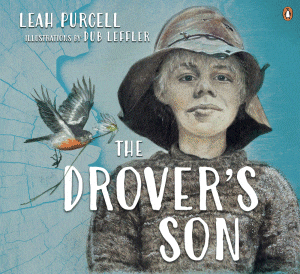
The Drover’s Son
The Drover’s Son
Leah Purcell
Dub Leffner
Puffin, 2026
40pp., hbk., RRP $A29.99
9781761341977
In 1892, renowned Australian storyteller Henry Lawson published his short story, The Drover’s Wife in which, through the life of Molly Johnson, he shone a spotlight on the courage and resilience of the pioneer women who followed their husbands to the rural and remote regions of Australia – in this case, the alpine country of New South Wales – and held the fort against the landscape, the isolation, and the dangers of the country while their husbands were away for months at a time trying to earn a living.
The original story has inspired artworks, retellings, and other interpretations including a play written by Leah Purcell, itself becoming a film, a book and an opera. Central to Molly Johnson’s story are her love for and protection of her children, and now, emerging from such auspicious beginnings, is this new picture book that focuses on her oldest son Danny, who believes he will have no choice but to leave home and go droving with his father. But then he meets Yadaka, an indigenous man, who despite the attitudes towards First Nations people at the time, takes Danny under his wing and shows him there can be another path – one in which a man can be wise and gentle, and a warrior too. “It’s not what you wear on your feet, Danny. How you carry yourself is what makes a decent man.”
Set in 1893, with the Ngarigo landscape and intriguing characters perfectly portrayed in Leffler’s exquisite illustrations, Purcell, herself, says, “This is a yarn about fathers and sons, a mother’s love, fierce and true, and about family in whatever form that takes. A tale of cautious meetings, bonding and the sharing of stories. Of lessons learnt and of cultural understanding and genuine respect. This is a story about a time in our history we shouldn’t forget.”
Although the primary story is Danny’s, Molly’s also remains central as she awaits the birth of yet another child, isolated and without modern medical assistance – giving today’s girls plenty of food for thought. How would they cope with being almost constantly pregnant, the likelihood of losing the baby anyway, while all the while having to take full responsibility for the other children 24/7?
Whether it is read and shared through the lens of the power and endurance of the women of the time; the attitudes towards and treatment of First Nations peoples; Yadaka’s connection to Country and heritage and the importance of that; the difference in childhood between then and now; the relationship between Yadaka and Danny and the importance of role models; the visual literacy of Leffler’s interpretation of a landscape and history that I see daily out my window; the reimagining of a story from long ago into so many versions so that it is as powerful today as it was then; or any other perspective this is a must-have addition to the collection that will open up so much of this nation’s early European history for older, independent readers.